
Direct Primary Care (DPC) is that alternative. Instead of billing insurance per visit, you pay your provider a flat membership fee and get direct, ongoing access to care. This 2026 guide covers what DPC costs, what it includes, where it falls short, and how to pick the right provider.
DPC has grown steadily nationwide, with directories now tracking thousands of practices across all 50 states. More patients want personalized care without the insurance runaround, and more providers are answering that call.
Key Takeaways
- Flat monthly memberships replace per-visit insurance billing for covered primary care
- Membership typically runs $50-$100+ per month, with family and senior tiers often higher
- Insurance is still needed for hospitalizations, specialists, and ER visits
- In-home and virtual DPC models are expanding access in 2026
- Compare services, communication access, and care philosophy when choosing a provider
What Is Direct Primary Care?
DPC is a membership-based primary care model that removes insurance billing from the patient-provider relationship entirely. You pay a flat monthly or annual fee directly to the practice, and that fee covers a defined set of services.
According to the American Academy of Family Physicians, a typical DPC membership includes:
- Office or in-home visits
- Basic lab work
- Preventive screenings
- Direct communication with your provider (portal, video, sometimes text)
A quick comparison: In traditional fee-for-service care, every visit, lab, and phone consult generates a separate bill, often processed through insurance with copays and deductibles. In DPC, that same relationship runs on one predictable fee, with no claims filed for primary care.
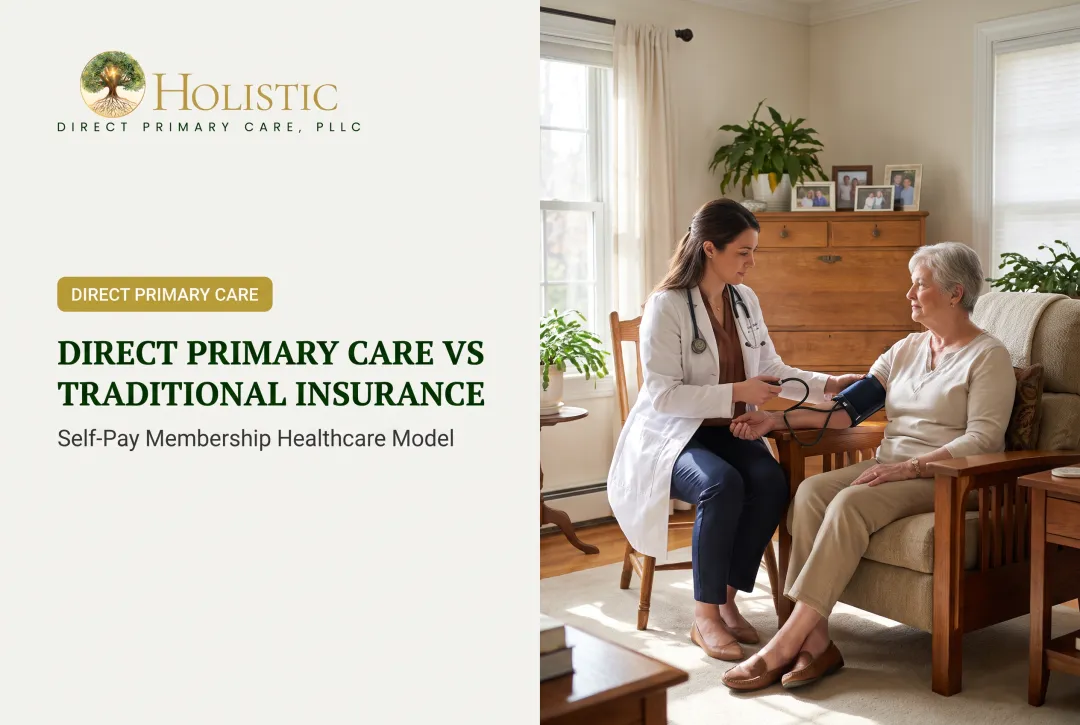
DPC is also evolving beyond the in-office model. Practices like Holistic Direct Primary Care in Bradenton, Florida now deliver care through in-home and virtual visits, so patients never need to sit in a waiting room.
DPC Availability Varies by State
Not every state treats DPC the same way. Washington and Texas have specific statutes recognizing direct-practice agreements. New York and New Jersey, by contrast, have no dedicated DPC law on the books as of this guide.
That doesn't mean DPC isn't available in those states. The model is growing nationwide, but the regulatory backdrop still differs depending on where you live.
How Direct Primary Care Works: Membership, Costs & Visits
Typical Membership Costs
National benchmarks from the AAFP's 2025 DPC FAQ put pricing at:
- Adults: $50-$100 per month
- Children: $20-$49 per month
- Families: $100+ per month
A separate industry survey found the average member pays close to $98.64/month, with urban practices running higher (around $110) than rural ones (around $82).
For context, Holistic Direct Primary Care structures its adult pricing by age:
| Age Group | Monthly Fee |
|---|---|
| 18-25 | $80 |
| 26-55 | $130 |
| 56+ | $155 |
| Snowbird (56+) | $620 seasonal (5 in-home visits) |

Compare that to a single uninsured visit, which can run into the hundreds once labs or follow-ups are added. A flat monthly fee is more predictable—especially if you need frequent check-ins.
Appointment & Access Structure
DPC visits typically run longer than the national average primary care visit, which researchers found was just 22.9 minutes in 2016. Many DPC practices build in 30-60 minute appointments, especially for new patients or complex concerns.
Members typically get:
- Same-day or next-day scheduling
- Portal messaging (often unlimited)
- Video visits
- In-home visits (at some practices)
- Smaller patient panels so your provider knows you
That smaller panel matters:
- Traditional primary care: ~2,300 patients per provider
- DPC practices: often 400-1,200 patients per provider
Fewer patients per provider means more time and attention for you.

Benefits of Choosing Direct Primary Care
DPC's appeal comes down to a handful of concrete advantages:
- Transparent pricing — no copays, no surprise bills from the practice
- Stronger relationships — more time per visit builds trust and continuity
- Preventive focus — chronic disease management and health education take priority over rushed symptom-chasing
- Whole-person care — some practices, like Holistic Direct Primary Care, explicitly address physical, mental, spiritual, and social wellbeing, not just what's on the chart
- Convenience — virtual visits are widely available, and some practices also offer in-home care that cuts travel time and missed work
A 2022 focus-group study of one DPC clinic found patients consistently praised communication, flexible scheduling, and affordability, though the study was small and specific to one practice. Take it as a data point, not a guarantee.
What Direct Primary Care Doesn't Cover
DPC is not comprehensive insurance. It's primary care. That means:
- Specialist visits, hospitalizations, surgeries, and imaging are not covered under the membership
- Emergency care is billed separately — a 2 a.m. ER visit is on you, insurance or not
This is why most DPC members pair their membership with a high-deductible health plan, catastrophic plan, or health-sharing arrangement to cover the bigger stuff.
HSA/FSA note: Under IRS guidance effective for 2026, a qualifying DPC arrangement no longer disqualifies you from HSA contributions. Fees must stay under $150/month for an individual or $300/month for a family arrangement.
Above those limits, contribution eligibility gets murky. Check with a tax professional before assuming your membership qualifies.
One clarification: cash-only practices and DPC aren't the same thing. Cash-only clinics bill you per visit, just without insurance. DPC bundles services into one flat membership fee, regardless of how many times you're seen that month.
DPC vs. Concierge Medicine vs. Traditional Insurance-Based Care
These three models differ most in how you pay, how large your clinician’s patient panel is, and how long visits usually run.
| Feature | Traditional Insurance-Based | Concierge | Direct Primary Care |
|---|---|---|---|
| Billing | Insurance per visit | Retainer + insurance billing | Flat membership only |
| Typical cost | Copay-dependent | Often $1,500+/year retainer, plus insurance | $50–$155/month |
| Patient panel | ~2,300 | Much smaller | 400–1,200 |
| Visit length | Under 23 minutes average | Extended | Extended |

Concierge medicine often charges a retainer on top of what insurance already covers, which puts it out of reach for many patients. DPC tends to be the more affordable, more accessible option.
Don't assume DPC means "basics only," either. Many DPC providers, particularly holistic ones, expand into functional medicine, hormone health, weight management, and IV therapy. Holistic Direct Primary Care, for example, layers functional and alternative medicine, supplement planning, and whole-person wellness support into its standard membership.
How to Find and Choose a Direct Primary Care Provider in 2026
Before signing up, run through this checklist:
- What's included — labs, medications at cost, wellness add-ons?
- Communication access — portal messaging, video, response times?
- Visit length — how much time do you actually get?
- Provider credentials — who's actually treating you?
- Cancellation terms — what's the commitment length?
- Emergency protocol — what happens if you're hospitalized?
Where to search: The DPC Frontier mapper lists thousands of practices by state. Use it to check availability in places like New York or New Jersey, where regulations are still catching up.
If whole-person care matters to you, look for practices that address physical, mental, spiritual, and social wellbeing together. Holistic Direct Primary Care's in-home and virtual approach is one example, delivering care in your own environment rather than a clinic exam room.
Before committing, call the practice directly. A short conversation often reveals more about fit, communication style, and follow-through than a website can—and lets you confirm the checklist details above.
Frequently Asked Questions
How much does it cost to see a primary care doctor without insurance?
Costs vary widely by location and services needed, often running well over $100 per visit once labs are added. A flat DPC membership typically covers unlimited visits for $50-$155 a month.
What does direct primary care (DPC) not cover?
DPC excludes specialist visits, hospitalizations, surgeries, imaging, and emergency care. Most members pair DPC with a high-deductible or catastrophic health plan to cover these gaps.
What does cash-based or cash-only medical practice mean?
Cash-only practices charge per visit without billing insurance. DPC differs by using one flat membership fee that covers ongoing primary care, regardless of visit frequency.
How do I find a direct primary care provider?
Search directories like the DPC Frontier mapper by state or region. Compare included services, communication access, and visit length before you enroll.
Is direct primary care available in my state, for example New York or New Jersey?
DPC is growing nationwide, though state regulations vary. New York and New Jersey have no DPC-specific statute, but practices still operate there and are listed in local directories.
Is direct primary care (DPC) only for primary care?
Not necessarily. Many DPC practices, especially holistic ones, expand into functional medicine, hormone health, IV therapy, and preventive wellness beyond basic primary care.